
Tensys
EX VAT
INC VAT
0 items £0.00
YOUR BASKET

You have no items in your basket

Tag: ratchet-straps

CE mark

When purchasing ratchet straps and other types of load restraint equipment, buyers are often told to look for a CE mark as evidence of compliance and safety. While that may be good advice for some products, it doesn't apply to web lashings manufactured to BS EN 12195-2:2001.

In fact, for transport operators, fleet managers and procurement teams, focusing on CE marking can distract from the information that actually matters when it comes to securing loads safely and demonstrating compliance.


What to Look for Instead

Web lashings used for load restraint on road vehicles are covered by BS EN 12195-2:2001, the recognised standard for web lashings manufactured from man-made fibres. This standard specifies requirements for design, manufacture, testing, marking and traceability.

When a driver secures a load, the important information is not whether a CE logo appears on the strap. What matters is whether the lashing has been manufactured and labelled in accordance with BS EN 12195-2.


Why CE Marking Isn't Relevant

The CE mark is only needed where specific legislation requires it. Not every product sold in the UK or Europe falls within this framework.

BS EN 12195-2 is a widely recognised product standard for load restraint equipment, but it is not a CE harmonised standard that requires manufacturers to apply a CE mark to their web lashings. Industry guidance and manufacturer documentation consistently recognise that lashings should demonstrate compliance through the requirements of BS EN 12195-2 rather than through CE marking.

For transport operators, this means that a strap without a CE mark is not necessarily non-compliant. And a strap that does have a CE mark is not automatically superior or safer.


Questions to Ask When Buying Ratchet Straps

Rather than asking suppliers whether their straps are CE marked, buyers should focus on the information that's directly relevant to load security and compliance.


1) Is the strap clearly labelled?

BS EN 12195-2 requires lashings to carry specific information, including:

  • Lashing capacity (LC)
  • Standard tension force (STF)
  • Standard hand force (SHF)
  • Strap material
  • Manufacturer details
  • Traceability information
  • Reference to EN 12195-2

This information allows operators to verify that the lashing is suitable for the application and provides the data needed for load securing calculations.

SEE ALSO: How to Read the Information on a Ratchet Strap Label


2) Is the manufacturer traceable?

Every professional transport operation should be able to identify where its restraint equipment came from.

Traceability enables:

  • Product recalls if required
  • Investigation of failures
  • Verification of test records
  • Demonstration of due diligence


3) Can the supplier support performance claims?

Buyers should be looking for:

  • Documented testing
  • Quality assurance procedures
  • Consistent manufacturing standards
  • Product traceability

These factors provide far greater assurance than the presence of a CE mark or any other logo on the label.


Why Label Information Matters During Roadside Inspections

During DVSA inspections, enforcement officers are interested in whether appropriate load securing equipment is being used.

The key information is normally found on the BS EN 12195-2 label. If a strap's label is missing, damaged or illegible, essential information such as the lashing capacity cannot be verified. Industry guidance notes that lashings without proper identification should not be used because compliance cannot be established.

For fleet operators, maintaining properly labelled restraint equipment is therefore far more important than
seeking out unnecessary product markings.


Avoid Being Misled by Marketing Claims

The transport industry has become increasingly familiar with terms such as:

  • "CE approved"
  • "CE certified"
  • "CE compliant"

But for ratchet straps and web lashings, these claims often create confusion rather than clarity.

As a buyer, your responsibility is to ensure that restraint equipment is fit for purpose and compliant with the relevant load restraint standard. The correct question is not "Is it CE marked?" but rather "Is it fully compliant with BS EN 12195-2 and correctly labelled?". That's what will give you meaningful assurance about the suitability of the product for load securing operations.


The Bottom Line

For transport operators, logistics companies and procurement professionals, the safest purchasing decision is to focus on compliance with BS EN 12195-2:2001, not on CE marking.

A quality lashing should provide:

  • Clear EN 12195-2 identification
  • Declared LC, STF and SHF values
  • Full traceability
  • Manufacturer information
  • Evidence of testing and quality control

These are the features that help keep loads secure, drivers safe and operators compliant.

When buying ratchet straps, don't ask for a CE mark. Ask for compliance with BS EN 12195-2. That's the standard that matters.
Buy Ratchet Straps from Tensys Direct

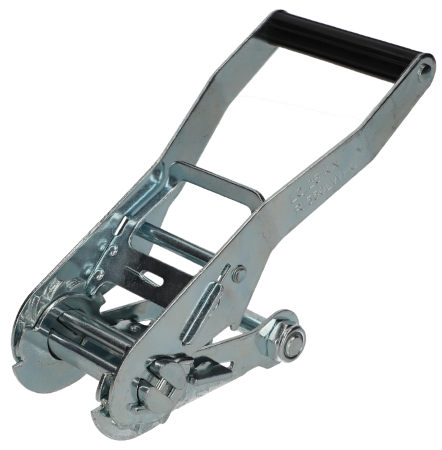
Ratchet buckle

To keep your ratchet buckles in optimum condition, we recommend regular lubrication after cleaning.

Recommended lubricant

Use a light dry silicone spray or PTFE dry lubricant on pivot points, gear teeth and the release mechanism. These sprays are commonly available and you may already have a supply in your workshop. Popular brands are WD40 Dry Lubricant (not standard WD40), GT85 and Action Can SP90 etc. Avoid heavy grease or over-application, as excess lubricant can attract grit and contaminate the webbing.

Apply a light spray to hinge pins, pawl, ratchet wheel teeth and release mechanism. Diagrams below shows the key areas to spray.

Lubrication tips

  • Operate the handle several times to distribute lubricant through moving parts
  • Wipe away all visible excess lubricant, especially near the strap path
  • Re-lubricate if the ratchet feels stiff, after heavy outdoor use, or after washing

Buy Ratchet Straps from Tensys Direct

5 tonne ratchet strap and 10 tonne ratchet strap

The biggest misconception is that a 10 tonne ratchet strap can secure twice the load of a 5 tonne strap. In practice, the difference is more nuanced.

FEATURE

5 TONNE RATCHET STRAP

10 TONNE RATCHET STRAP

Typical Webbing Width

50mm (2 inch)

75mm (3 inch)

Breaking Force (BF)

5,000kg (5,000daN)

10,000kg (10,000daN)

Lashing Capacity (LC)

Typically 2,500daN (kg)

Typically 5,000daN (kg)

Ratchet Size

Standard 230mm long

Heavy duty 325mm long

STF (Tension Force)

Lower

Higher

Weight

Lighter 0.9kg per buckle

Heavier 3.13kg per buckle

Common Uses

General haulage, trailers, machinery, pallets

Heavy plant, steel, abnormal loads, specialist transport

Strength

A 10 tonne strap is manufactured with heavier webbing and a larger ratchet, giving:

  • Higher breaking force
  • Higher lashing capacity
  • Higher standard tension force (STF)

This means it can apply more restraining force when tensioned.

Practical Example

For...

  • Palletised goods
  • Building materials
  • General curtain-sided loads
  • Small plant and machinery

...a 50mm 5 tonne strap is usually the industry standard.

For...

  • Excavators
  • Large plant equipment
  • Steel fabrications
  • Abnormal loads

A 75mm 10 tonne strap is often preferred because it provides more restraint force and is more resistant to damage from sharp edges and abrasion.

Size & Handling

A 10 tonne strap is considerably:

  • Heavier
  • Bulkier
  • Harder to throw over loads
  • More expensive

Many operators prefer to use several 5 tonne straps rather than one 10 tonne strap because they are easier to handle and often provide better load distribution.

Compliance

Under BS EN 12195 load securing calculations, simply fitting a stronger strap does not automatically mean you can use fewer straps. The required number is determined by:

  • Load weight
  • Friction coefficient between load and truck/trailer
  • Securing method
  • STF value
  • Load dimensions

This is why STF-based lashing calculations are important for determining the actual number of straps required.

Rule of Thumb

Choose a 5 tonne strap when:

  • General haulage loads are being secured
  • Ease of handling is important
  • Standard UK transport applications are involved

Choose a 10 tonne strap when:

  • Securing heavy plant or abnormal loads
  • Higher STF is required
  • Extra durability and robustness are needed

For most UK haulage operators, a quality 50mm 5 tonne ratchet strap remains the go-to restraint product, while 10 tonne straps are generally reserved for specialist heavy-duty applications.

Buy Ratchet Straps from Tensys Direct

Solar panels installed at Arinsdale's Grangemouth facility

Not the newspaper – the big bright one in the sky!

At Arinsdale, we believe that manufacturing excellence and environmental responsibility should go hand in hand. That's why we're proud to announce a major investment in sustainable energy at our Grangemouth facility, with the installation of a new 70kW solar panel array.

This investment means that the electricity powering our production and warehouse operations is now increasingly generated on-site from renewable solar energy. As a result, our UK-manufactured ratchet straps are being produced with a reduced environmental footprint while maintaining the quality, reliability and traceability our customers expect.

Investing in UK Manufacturing

Rising energy costs continue to challenge manufacturers across the UK. Rather than outsourcing production overseas, we've chosen to invest in both British manufacturing and sustainable infrastructure. Our new solar installation helps support long-term production efficiency while reinforcing our commitment to keeping manufacturing jobs, skills and expertise here in the UK.

A More Sustainable Future

Every ratchet strap we manufacture requires power for cutting, sewing, printing, testing and warehousing. By generating renewable energy on-site, we're reducing our reliance on grid electricity and taking a practical step towards a more sustainable future.

This latest investment reflects our long-standing commitment to continuous improvement, responsible manufacturing and supporting our customers with high-quality UK-made load restraint products.

Made in Britain, Powered by the Sun

When you choose a ratchet strap from Arinsdale, you're not only supporting UK manufacturing – you're also supporting a business that is actively investing in cleaner, more sustainable production.

Buy Ratchet Straps from Tensys Direct

Ratchet strap buckle

Ratchet buckles are a simple mechanism but aren't maintenance free.

Maintaining ratchet buckles properly ensures they stay safe, functional, and long-lasting.

Here's a straightforward guide to help you keep them in good condition:

1. Regular Cleaning

  • After use, especially in dirty or wet environments, clean the buckle and strap.

  • Use warm water and mild soap to remove dirt, grease, or salt.

  • Avoid harsh chemicals that could degrade the metal or strap material.

  • Dry thoroughly to prevent rust or mildew.

2. Lubrication

  • Apply a light lubricant (like WD-40DRY, PTFE or silicone spray) to the moving parts of the ratchet mechanism.

  • Wipe off excess to avoid attracting dust and debris.

  • Do this periodically or if the ratchet feels stiff.

3. Inspection

  • Check for fraying, cuts, or excessive wear on the strap.

  • Inspect the ratchet teeth and handle for damage or deformation.

  • Ensure the release mechanism works smoothly.

4. Storage

  • Store in a dry, cool place away from direct sunlight.

  • Avoid leaving them exposed to the elements for long periods.

  • Coil the straps neatly to prevent tangling or creasing.

5. Usage Tips

  • Don't over-tighten as this can damage both the buckle and the cargo.

  • Always align the strap properly in the ratchet to avoid jamming.

  • Use the correct strap rating for the load you're securing.

Feel free to get in touch if you have any questions about how to look after your Tensys ratchet straps. You may also want to download our handy maintenance checklist and log (PDF opens in new window).

Buy Ratchet Straps from Tensys Direct

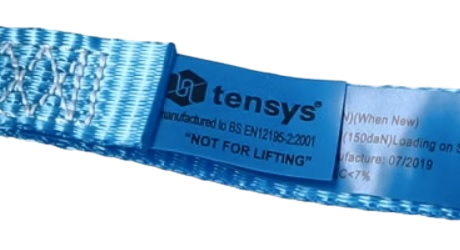
Tensys ratchet strap label with 'NOT FOR LIFTING' warning

SHORT ANSWER: No, you cannot use ratchet straps for lifting. Ratchet straps are designed to secure loads in place during transport; they are not designed, tested or certified for lifting applications.

Ratchet straps can be extremely useful if you're trying to stop cargo shifting around while you're on the road, but they are not lifting slings and should not be used as such.

Every Tensys ratchet strap has the words NOT FOR LIFTING printed clearly on the label. This warning is there for a very good reason: using a ratchet strap to lift or lower a load may cause the strap to fail, potentially causing severe damage and/or injuries.

If you need to lift a load, you must use suitable lifting equipment such as a certified lifting sling. Luckily, we also sell textile lifting slings that are specifically made for heavy lifting jobs.

Tensys ratchet strap

If you've ever looked closely at one of our ratchet strap labels, you may have spotted the term BFmin. This is short for minimum breaking force – a very important measurement, and one that's often misunderstood.

Basically, the minimum breaking force is your brand new ratchet strap's absolute limit. If the strap is subjected to forces equalling or exceeding the BFmin, the strap will fail.

BFmin should not be confused with the strap's lashing capacity (LC), which refers to the maximum force your ratchet strap is designed to sustain in actual working conditions.

Read on to learn more about BFmin and what it actually means in relation to our ratchet straps.

Endless ratchet strap

An endless ratchet strap is a type of lashing strap that forms a continuous loop around your load instead of terminating in a hook or other endfitting.