
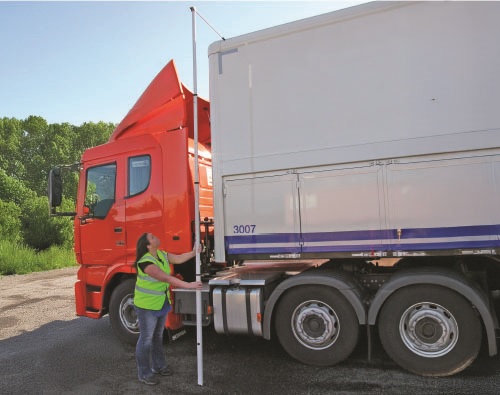
The safest and most accurate way to measure the combined height of your vehicle and its load is to measure from the ground to the highest point of the vehicle or load after everything has been fully loaded up and secured.
Height measuring sticks (telescopic load height poles) are commonly used in the transport industry specifically for this purpose.
According to Network Rail, bridge strikes cost the UK economy about £23 million every year, with an average cost of £13,000 for each individual incident. Network Rail now tries to recover 100% of these costs from the transport company or driver responsible. Investing a few hundred pounds in equipment and training significantly reduces the potential risk.
The following pages have some useful information on this topic:
- Wise Up, Size Up (Network Rail safety campaign)
- How to prevent vehicles from hitting bridges (UK government guidance)
Method 1: Telescopic Height Pole (Recommended)
- Park on level ground.
- Load and secure the vehicle exactly as it will travel.
- Extend the height pole beside the vehicle until it touches the highest point.
- Read the measurement directly from the scale.
- Record the height in the cab and on any transport documentation if required.
This is the quickest vehicle/load height measurement method for flatbeds, curtain-siders carrying awkward loads, plant trailers and abnormal loads.
Method 2: Measure Vehicle Height + Load Height
If you don't have a height stick that would allow you to measure the full height of the loaded-up vehicle, you can use this method instead:
- Measure the trailer deck height from the ground.
- Measure the load height from the trailer bed to the highest point of the load.
- Add these two measurements together
For example, if your trailer deck height is 1.35 metres and the load height is 2.5 metres, the total height of your loaded-up vehicle will be 3.85 metres.
Best Practices
For haulage operators, we normally recommend:
- Measuring every unusual or high load.
- Writing the overall height on a dashboard card or display, and keeping this within sight for quick reference against bridge road signs.
- Checking for route restrictions before departure (see below for advice).
- Re-measuring to confirm your vehicle height if it's close to 4.95m or any route restriction.
- Bearing in mind that suspension changes and tyre pressures can alter vehicle height slightly.
- Ensuring that all equipment is securely lashed and locked in position so that (for example) booms and jibs can't extend during the journey.
Route Restrictions
Before setting off with a loaded vehicle, these are the key route restrictions that should be checked:
1) Bridge Height Restrictions
This is the most critical check for high loads. Look for...
- Low bridges
- Railway bridges
- Footbridges
- Temporary bridge works
- Locations of past bridge strikes
Your measured vehicle height must be lower than the posted clearance. Bridge strikes are a significant cause of infrastructure damage and transport incidents, so don't drive under a bridge unless you know for sure that the combined height of your vehicle and load is low enough to fit.
2) Overhead Services
Bridges aren't the only overhead hazard you need to be mindful of. You should also check for...
- Power lines
- Telephone and data cables
- Pipe bridges
- Conveyor crossings
- Overhead gantries
These can be lower than standard road structures, particularly in industrial estates, ports and construction sites.
Here at Tensys Direct, we stock height sticks with imperial and metric scales to help you measure your vehicle's height easily and accurately. Click the button below to browse and buy.