
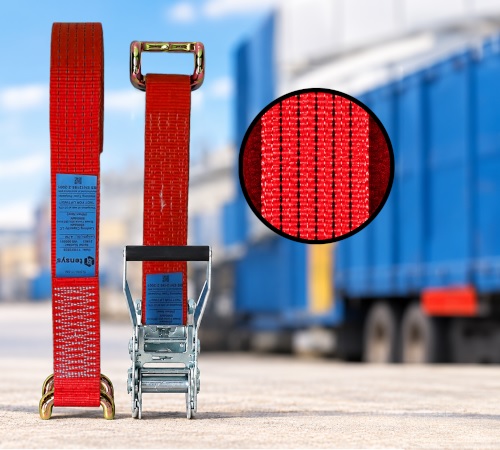
Five stripes are widely associated with a 5.0 tonne ratchet strap, but the stripes alone do not prove its rating. The label, the product standard and the strength of the webbing are what matter.
The short answer
No, five stripes on the webbing don't automatically mean that a ratchet strap is rated at 5.0 tonnes.
Stripes are an established industry convention, but they are not a rating requirement in the relevant product standards. Both 6.0 tonne and 7.5 tonne break-strength webbing can be manufactured with five stripes, so the two can look virtually identical to an untrained eye. (With experience, the difference in polyester yarn content can be checked by both weight and touch.)
Stripes are often present on one side only so that, when the strap is placed over the load, users can easily see any twists in the webbing.
The reliable way to identify a strap is to read its sewn-in label and confirm that the complete assembly is correctly rated to the applicable standard. Appearance is not a substitute for specification.
Why ratchet straps are labelled in daN
Ratchet straps are rated and labelled in decanewtons (daN). A decanewton is a unit of force, rather than a measurement of static weight. In everyday industry language, however, a 5000 daN lashing is commonly described as a '5.0 tonne' ratchet strap.
The term has been familiar to users since the late 1980s, when straps were produced to BS 5759:1987. Although the terminology remains useful commercially, buyers should remember that lashing capacity is a force rating for the complete restraint system. It should not be treated as a simple statement that the strap can secure a static load of the same weight.
What changed when the standard changed?
BS 5759:1987 was superseded by BS EN 12195-2:2001. The newer standard upgraded the specification requirements and changed the webbing strength needed for a strap carrying the familiar 5000 daN rating.
Under the older standard, a nominal 5.0 tonne strap was fitted with webbing having a 6.0 tonne break strength when new, unsewn and tested as webbing. For a 5000 daN strap made to BS EN 12195-2:2001, the webbing must instead have a 7.5 tonne break strength.
|
Product basis
|
Webbing break strength
|
Appropriate assembly rating
|
|---|---|---|
|
Legacy BS 5759:1987 specification
|
6.0 tonnes
|
Historically sold as 5.0 tonne
|
|
BS EN 12195-2:2001 specification |
7.5 tonnes |
5000 daN |
The hidden difference behind identical-looking webbing
This is where the five-stripe assumption becomes risky. A 6.0 tonne webbing and a 7.5 tonne webbing may both carry the same five-stripe pattern. Looking at the strap across a yard, in a photograph or even close up will not necessarily reveal which specification has been used.
The material cost difference can be small – approximately £0.10 per metre. On a typical 10.0 metre strap, that equates to around £1.00 total difference. This creates a commercial temptation to use the lower-strength 6.0 tonne webbing while presenting the completed strap as a higher-rated product.
A strap produced to the current standard with 6.0 tonne break-strength webbing should be rated at no more than 4000 daN. Labelling that construction at 5000 daN would give the user a rating that the webbing specification does not support.
Why the label matters more than the stripes
There is no product-standard requirement for lashing webbing to use stripes as a capacity code. The stripes are useful because customers recognise them, and most manufacturers do follow the convention, but they are not evidence of compliance on their own.
A buyer should check that the label clearly identifies:
- The lashing capacity in daN
- The applicable standard
- The manufacturer or supplier responsible for the assembly
If the strap is sold as 5000 daN, it should be backed by the correct 7.5 tonne break-strength webbing and a complete construction that meets BS EN 12195-2:2001 requirements.
What should buyers ask?
Before buying or specifying a 5000 daN strap, ask the supplier to confirm the webbing break strength, the standard to which the assembly is manufactured and the evidence supporting the rating. A reputable manufacturer should be able to answer those questions clearly.
If two products look identical, but one is significantly cheaper, the difference may not be visible in the stripe pattern. It may be in the webbing specification, the components, the stitching, or the quality controls behind the finished assembly.
The takeaway
Five stripes are a familiar visual cue, not a certified capacity rating. A genuine 5000 daN ratchet strap that's certified to BS EN 12195-2:2001 requires the correct higher-strength webbing and a properly-rated complete assembly.
Do not buy the stripes. Buy the specification, the label and the assurance that the product has been manufactured and rated correctly.
For correctly specified UK-manufactured ratchet straps and technical guidance, speak to Arinsdale about the Tensys range.
Buy Ratchet Straps from Tensys Direct
Technical basis supplied by Arinsdale. Ratings discussed apply to lashing assemblies; ratchet straps must not be used for lifting.