
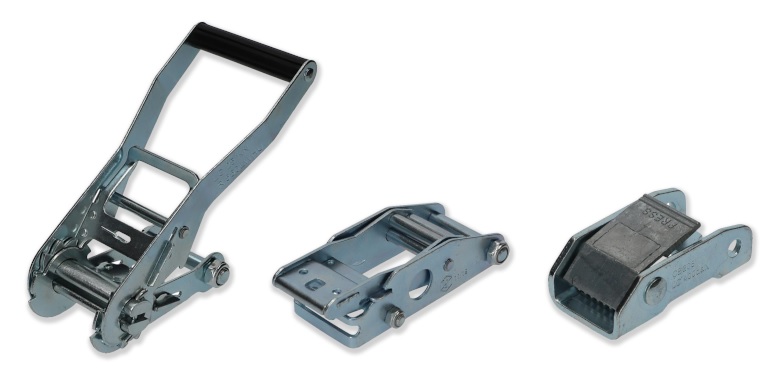
A practical guide to choosing load-securing tensioners. Pictured above: ratchet R550LWHU (left), overcentre buckle OB423LK (middle) and cambuckle CB208 (right).
The differences at a glance
| BUCKLE | TYPICAL ADVANTAGE | MAIN LIMITATION | POTENTIAL FIT* |
| Ratchet |
Lever-assisted, incremental tension |
Overtensioning; size and handle clearance |
Loads needing a specified pretension applied |
| Overcentre |
Fast repeatable closure after adjustment |
Limited take-up; sensitive setup |
Repeat-use assemblies; curtain tensioning internal box van straps, etc. |
| Cambuckle | Compact, quick hand adjustment | Hand-limited pretension; cargo still vulnerable | Lighter or delicate items, small items in passenger vehicles, vans & roof rack loads |
*Indicative operating characteristics only. Every application requires a suitable rated assembly; side curtain tensioning is not cargo restraint without BS EN 12642-XL certification.
Three mechanisms, different compromises
A buckle is not a complete load-securing solution. Ratchets, overcentre buckles and cambuckles hold or tension webbing differently, but their suitability depends on the lashing capacity required, the cargo/load and the transport forces involved. Choosing by appearance, familiarity or a claim of 'heavy duty' can miss the essentials.
This guide compares typical operating characteristics, not universal capacity rankings. Designs vary, and a buckle that works well on one assembly may be unsuitable on another. Start with the restraint method and manufacturer's instructions, then choose hardware that operators can use correctly in the space available. [1]
Ratchets: leverage and adjustable pretensions
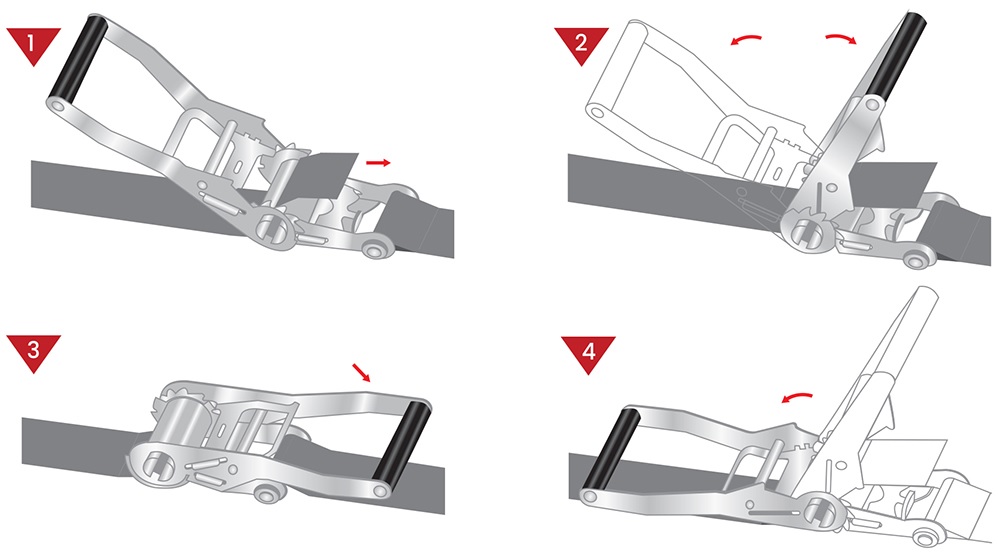
A ratchet tensioner winds webbing onto a spool. Operating the lever advances it in steps, while a pawl holds the mechanism between strokes. This mechanical advantage can develop substantial pretension (the tension applied to the webbing and transferred to the load before the vehicle moves). This can be useful in situations that require powerful and controlled tensioning, rather than simply taking slack out of a strap by hand.
Exact pretension force depends on webbing width. Ratchets can provide a pretension force of 150 daN (kg) for a 25mm wide strap, up to 950 daN (kg) for a 50mm strap with a geared ergo ratchet, with several options in between.
The main advantages of a ratchet are incremental adjustment and the ability to tension an appropriate assembly without relying solely on hand pull force.
The disadvantages follow from that leverage. Excess tension can crush packaging, mark surfaces or damage cargo. In box van vehicles, if the hooks aren't placed down the side of the load, the force applied by the ratchet can damage the anchor tracking. The ratchet mechanism is relatively bulky and needs clearance for the handle to be operated, but can be misused through incorrect threading or winding.
Please follow the specific instructions for each buckle; there is no safe universal threading shortcut. Ratchets can suit palletised goods and as a suitable equipment restraint, provided the load, anchors and lashing capacity match the task. They are not automatically the best answer for heavy machinery: the required restraint method (over the top or directly connected) and attachment geometry decide that. Confirm that the mechanism is properly locked before travel and at regular stages throughout the journey. [1][2]
Operation of ratchet buckle strap
Buy Ratchet Tensioners from Tensys Direct
Overcentre buckles: quick closure, careful setup
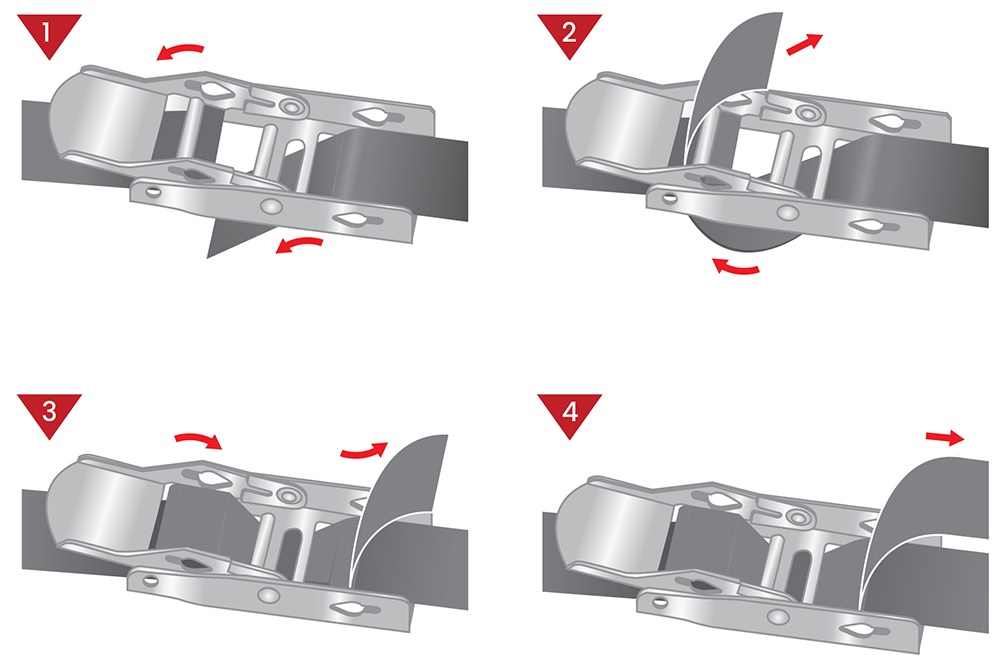
An overcentre buckle tensions through a short lever movement past the centre axis point after the working length (tension end) has been adjusted by hand. Unlike a ratchet, it does not wind webbing onto a spool. Its appeal is a decisive closing stroke, especially when the same arrangement is opened and closed repeatedly while pulling the tension end by hand.
That short stroke also limits how much slack it can take up. Set too loose, it may close without achieving the required tension; set too tight, it may be difficult to close the buckle, which may overstress the assembly. Changing load dimensions can therefore mean readjustment rather than a quick lever movement. Check the closure and ensure that any locking provision is engaged (can be simple idents, spring-loaded push buttons or pull catches) rather than assuming the mechanism cannot open.
Suitable applications include correctly specified repeat-use restraint assemblies and curtain-tensioning systems. These are distinct applications. An ordinary buckle pulling a curtainsider curtain taut does not automatically restrain the cargo behind it unless it's a positive fit load and the bodywork is certified to BS EN 12642-XL. Internal restraint assemblies must be identified and used within their own instructions and limits. Load restraint assemblies for securing cargo and roll cages in box vans commonly use overcentre-type buckles too. [1]
Operation of over-centre buckle strap
Buy Overcentre Buckles from Tensys Direct
Cambuckles: compact, hand-pulled adjustment
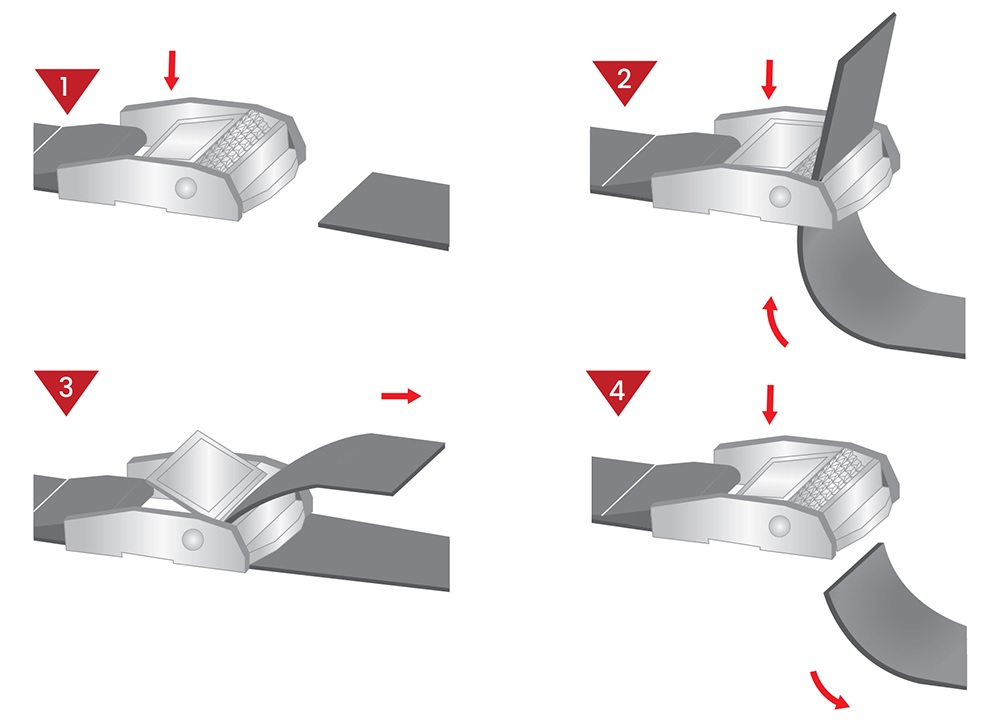
A spring-loaded toothed cam grips the webbing; tension comes from pulling the strap by hand. [3] This makes a cambuckle a compact option for straightforward adjustment, without a winding spool or repeated ratchet strokes. It can be convenient where handling space is limited and the specified restraint does not need high pretension.
The trade-off is generally a lower achievable pretension than a ratchet or overcentre buckle arrangement. Hand force, access and design affect the result. Less leverage may help to control pressure on vulnerable goods, but it is not protection against overtightening: even hand-pulled webbing can damage a fragile edge or finish. Keep the buckle away from surfaces it could mark by placing a pad or soft material under the buckle.
Possible uses include securing lighter equipment and delicate items where a suitable lashing capacity meets the requirement/application. Do not substitute a cambuckle merely because the load looks small. If the arrangement depends on pretension that cannot reliably be achieved by hand, a different tensioning system or restraint method is needed.
Operation of cam buckle strap
Buy Cambuckles from Tensys Direct
Read the label, not just the buckle
Lashing capacity (LC) is a force rating, not a permissible cargo weight. A value in daN (decanetwons) expresses force, not kilograms. Breaking strength is neither LC nor the tension an operator applies. The weakest component governs the assembly, so webbing, stitching, fittings, buckle and anchors all need consideration. [1]
For frictional tie-down, consider the appropriate standard tension force (STF), the achieved pretension, lashing geometry and friction factors. Direct restraint, a connection between the anchor point on the vehicle and on the load itself, instead uses LC and geometry to resist movement.
These are different design approaches, not interchangeable label numbers. Obtain competent selection advice for the actual load and vehicle; this comparison is not a restraint calculation guide. [1]
A practical selection checklist
- Confirm whether the job is cargo restraint, curtain tensioning or another purpose. Do not treat them as equivalent.
- Identify the load's movement risks, vulnerable friction surfaces and suitable attachment points before choosing the tensioner.
- Check the complete assembly's label, webbing compatibility and intended application, not a component buckle's advertised strength.
- Allow space for tightening, inspection and controlled release. Consider changing load sizes and the effect repeated application cycles have.
- Confirm the restraint method and required performance with a competent adviser; provide operators with equipment-specific training.
The safety takeaway
Inspect every component before use, including webbing, stitching, fittings and the buckle. Remove suspect equipment from service, use suitable strong anchor points and protect webbing against sharp edges with sleeves or plastic corner protectors. Never knot a tensioned strap or use load-restraint straps for lifting. Before releasing any buckle, check that the load is stable, then follow the manufacturer's safe-release procedure. Store equipment dry and protected when not in use. [1][2]
Ratchets offer leverage, overcentre buckles offer quick repeat closure, and cambuckles offer compact hand adjustment. None replaces a suitably-rated system, sound loading practice or a trained operator. The best choice is the one that meets the restraint requirement and can be used correctly, consistently and safely.
Buy Tensioners from Tensys Direct
References and further reading
- DVSA, Securing loads on HGVs and goods vehicles, section 4: Ways to secure a load (updated 24 September 2026). https://www.gov.uk/guidance/securing-loads-on-hgvs-and-goods-vehicles/4-ways-to-secure-a-load-in-an-hgv-or-goods-vehicle
- Highways England, Ratchet straps: What you need to know (2021). https://assets.highwaysengland.co.uk/Commercial%20Vehicles/Ratchet%20Strap%20Leaflet.pdf
- Tensys Direct, Cambuckle Straps. https://www.tensysdirect.com/categories/cambuckle-straps
Sources 1 and 2: Crown copyright, used under the Open Government Licence v3.0. Supplier references support mechanism descriptions only; inclusion is not an endorsement.