
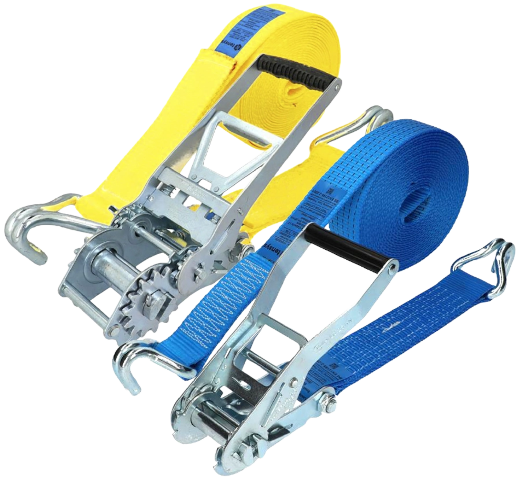
The biggest misconception is that a 10 tonne ratchet strap can secure twice the load of a 5 tonne strap. In practice, the difference is more nuanced.
| FEATURE |
5 TONNE RATCHET STRAP |
10 TONNE RATCHET STRAP |
|---|---|---|
| Typical Webbing Width |
50mm (2 inch) |
75mm (3 inch) |
| Breaking Force (BF) |
5,000kg (5,000daN) |
10,000kg (10,000daN) |
| Lashing Capacity (LC) |
Typically 2,500daN (kg) |
Typically 5,000daN (kg) |
| Ratchet Size |
Standard 230mm long |
Heavy duty 325mm long |
| STF (Tension Force) |
Lower |
Higher |
| Weight |
Lighter 0.9kg per buckle |
Heavier 3.13kg per buckle |
| Common Uses |
General haulage, trailers, machinery, pallets |
Heavy plant, steel, abnormal loads, specialist transport |
Strength
A 10 tonne strap is manufactured with heavier webbing and a larger ratchet, giving:
- Higher breaking force
- Higher lashing capacity
- Higher standard tension force (STF)
This means it can apply more restraining force when tensioned.
Practical Example
For...
- Palletised goods
- Building materials
- General curtain-sided loads
- Small plant and machinery
...a 50mm 5 tonne strap is usually the industry standard.
For...
- Excavators
- Large plant equipment
- Steel fabrications
- Abnormal loads
A 75mm 10 tonne strap is often preferred because it provides more restraint force and is more resistant to damage from sharp edges and abrasion.
Size & Handling
A 10 tonne strap is considerably:
- Heavier
- Bulkier
- Harder to throw over loads
- More expensive
Many operators prefer to use several 5 tonne straps rather than one 10 tonne strap because they are easier to handle and often provide better load distribution.
Compliance
Under BS EN 12195 load securing calculations, simply fitting a stronger strap does not automatically mean you can use fewer straps. The required number is determined by:
- Load weight
- Friction coefficient between load and truck/trailer
- Securing method
- STF value
- Load dimensions
This is why STF-based lashing calculations are important for determining the actual number of straps required.
Rule of Thumb
Choose a 5 tonne strap when:
- General haulage loads are being secured
- Ease of handling is important
- Standard UK transport applications are involved
Choose a 10 tonne strap when:
- Securing heavy plant or abnormal loads
- Higher STF is required
- Extra durability and robustness are needed
For most UK haulage operators, a quality 50mm 5 tonne ratchet strap remains the go-to restraint product, while 10 tonne straps are generally reserved for specialist heavy-duty applications.