Tensys
EX VAT
INC VAT
0 items £0.00
YOUR BASKET

You have no items in your basket

Archive

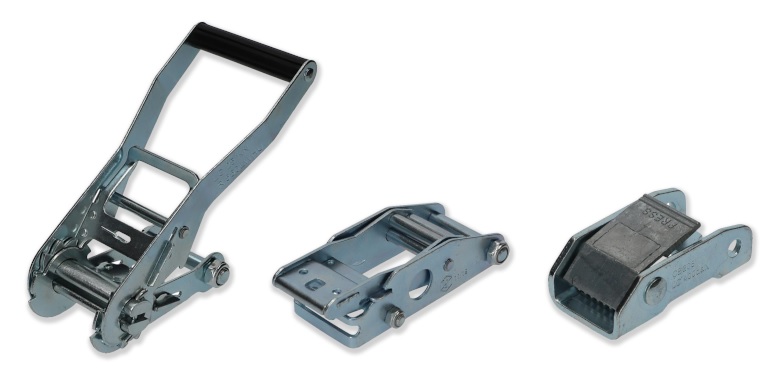
From left to right: a ratchet tensioner, an overcentre buckle and a cambuckle.

A practical guide to choosing load-securing tensioners. Pictured above: ratchet R550LWHU (left), overcentre buckle OB423LK (middle) and cambuckle CB208 (right).


The differences at a glance

BUCKLE TYPICAL ADVANTAGE MAIN LIMITATION POTENTIAL FIT*
Ratchet

Lever-assisted, incremental tension

Overtensioning; size and handle clearance

Loads needing a specified pretension applied

Overcentre

Fast repeatable closure after adjustment

Limited take-up; sensitive setup

Repeat-use assemblies; curtain tensioning internal box van straps, etc.

Cambuckle Compact, quick hand adjustment Hand-limited pretension; cargo still vulnerable Lighter or delicate items, small items in passenger vehicles, vans & roof rack loads

*Indicative operating characteristics only. Every application requires a suitable rated assembly; side curtain tensioning is not cargo restraint without BS EN 12642-XL certification.


Three mechanisms, different compromises

A buckle is not a complete load-securing solution. Ratchets, overcentre buckles and cambuckles hold or tension webbing differently, but their suitability depends on the lashing capacity required, the cargo/load and the transport forces involved. Choosing by appearance, familiarity or a claim of 'heavy duty' can miss the essentials.

This guide compares typical operating characteristics, not universal capacity rankings. Designs vary, and a buckle that works well on one assembly may be unsuitable on another. Start with the restraint method and manufacturer's instructions, then choose hardware that operators can use correctly in the space available. [1]


Ratchets: leverage and adjustable pretensions

A ratchet tensioner winds webbing onto a spool. Operating the lever advances it in steps, while a pawl holds the mechanism between strokes. This mechanical advantage can develop substantial pretension (the tension applied to the webbing and transferred to the load before the vehicle moves). This can be useful in situations that require powerful and controlled tensioning, rather than simply taking slack out of a strap by hand.

Exact pretension force depends on webbing width. Ratchets can provide a pretension force of 150 daN (kg) for a 25mm wide strap, up to 950 daN (kg) for a 50mm strap with a geared ergo ratchet, with several options in between.

The main advantages of a ratchet are incremental adjustment and the ability to tension an appropriate assembly without relying solely on hand pull force.

The disadvantages follow from that leverage. Excess tension can crush packaging, mark surfaces or damage cargo. In box van vehicles, if the hooks aren't placed down the side of the load, the force applied by the ratchet can damage the anchor tracking. The ratchet mechanism is relatively bulky and needs clearance for the handle to be operated, but can be misused through incorrect threading or winding.

Please follow the specific instructions for each buckle; there is no safe universal threading shortcut. Ratchets can suit palletised goods and as a suitable equipment restraint, provided the load, anchors and lashing capacity match the task. They are not automatically the best answer for heavy machinery: the required restraint method (over the top or directly connected) and attachment geometry decide that. Confirm that the mechanism is properly locked before travel and at regular stages throughout the journey. [1][2]

Operation of ratchet buckle strap

Buy Ratchet Tensioners from Tensys Direct


Overcentre buckles: quick closure, careful setup

An overcentre buckle tensions through a short lever movement past the centre axis point after the working length (tension end) has been adjusted by hand. Unlike a ratchet, it does not wind webbing onto a spool. Its appeal is a decisive closing stroke, especially when the same arrangement is opened and closed repeatedly while pulling the tension end by hand.

That short stroke also limits how much slack it can take up. Set too loose, it may close without achieving the required tension; set too tight, it may be difficult to close the buckle, which may overstress the assembly. Changing load dimensions can therefore mean readjustment rather than a quick lever movement. Check the closure and ensure that any locking provision is engaged (can be simple idents, spring-loaded push buttons or pull catches) rather than assuming the mechanism cannot open.

Suitable applications include correctly specified repeat-use restraint assemblies and curtain-tensioning systems. These are distinct applications. An ordinary buckle pulling a curtainsider curtain taut does not automatically restrain the cargo behind it unless it's a positive fit load and the bodywork is certified to BS EN 12642-XL. Internal restraint assemblies must be identified and used within their own instructions and limits. Load restraint assemblies for securing cargo and roll cages in box vans commonly use overcentre-type buckles too. [1]

Operation of over-centre buckle strap

Buy Overcentre Buckles from Tensys Direct


Cambuckles: compact, hand-pulled adjustment

A spring-loaded toothed cam grips the webbing; tension comes from pulling the strap by hand. [3] This makes a cambuckle a compact option for straightforward adjustment, without a winding spool or repeated ratchet strokes. It can be convenient where handling space is limited and the specified restraint does not need high pretension.

The trade-off is generally a lower achievable pretension than a ratchet or overcentre buckle arrangement. Hand force, access and design affect the result. Less leverage may help to control pressure on vulnerable goods, but it is not protection against overtightening: even hand-pulled webbing can damage a fragile edge or finish. Keep the buckle away from surfaces it could mark by placing a pad or soft material under the buckle.

Possible uses include securing lighter equipment and delicate items where a suitable lashing capacity meets the requirement/application. Do not substitute a cambuckle merely because the load looks small. If the arrangement depends on pretension that cannot reliably be achieved by hand, a different tensioning system or restraint method is needed.

Operation of cam buckle strap

Buy Cambuckles from Tensys Direct


Read the label, not just the buckle

Lashing capacity (LC) is a force rating, not a permissible cargo weight. A value in daN (decanetwons) expresses force, not kilograms. Breaking strength is neither LC nor the tension an operator applies. The weakest component governs the assembly, so webbing, stitching, fittings, buckle and anchors all need consideration. [1]

For frictional tie-down, consider the appropriate standard tension force (STF), the achieved pretension, lashing geometry and friction factors. Direct restraint, a connection between the anchor point on the vehicle and on the load itself, instead uses LC and geometry to resist movement.

These are different design approaches, not interchangeable label numbers. Obtain competent selection advice for the actual load and vehicle; this comparison is not a restraint calculation guide. [1]


A practical selection checklist

  • Confirm whether the job is cargo restraint, curtain tensioning or another purpose. Do not treat them as equivalent.

  • Identify the load's movement risks, vulnerable friction surfaces and suitable attachment points before choosing the tensioner.

  • Check the complete assembly's label, webbing compatibility and intended application, not a component buckle's advertised strength.

  • Allow space for tightening, inspection and controlled release. Consider changing load sizes and the effect repeated application cycles have.

  • Confirm the restraint method and required performance with a competent adviser; provide operators with equipment-specific training.


The safety takeaway

Inspect every component before use, including webbing, stitching, fittings and the buckle. Remove suspect equipment from service, use suitable strong anchor points and protect webbing against sharp edges with sleeves or plastic corner protectors. Never knot a tensioned strap or use load-restraint straps for lifting. Before releasing any buckle, check that the load is stable, then follow the manufacturer's safe-release procedure. Store equipment dry and protected when not in use. [1][2]

Ratchets offer leverage, overcentre buckles offer quick repeat closure, and cambuckles offer compact hand adjustment. None replaces a suitably-rated system, sound loading practice or a trained operator. The best choice is the one that meets the restraint requirement and can be used correctly, consistently and safely.

Buy Tensioners from Tensys Direct


References and further reading

  1. DVSA, Securing loads on HGVs and goods vehicles, section 4: Ways to secure a load (updated 24 September 2026). https://www.gov.uk/guidance/securing-loads-on-hgvs-and-goods-vehicles/4-ways-to-secure-a-load-in-an-hgv-or-goods-vehicle

  2. Highways England, Ratchet straps: What you need to know (2021). https://assets.highwaysengland.co.uk/Commercial%20Vehicles/Ratchet%20Strap%20Leaflet.pdf

  3. Tensys Direct, Cambuckle Straps. https://www.tensysdirect.com/categories/cambuckle-straps

Sources 1 and 2: Crown copyright, used under the Open Government Licence v3.0. Supplier references support mechanism descriptions only; inclusion is not an endorsement.
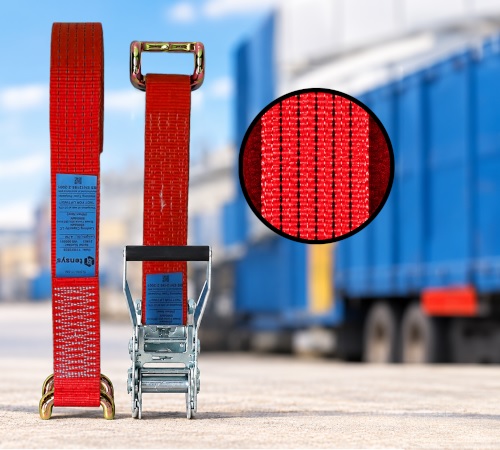
A ratchet stap with five stripes on the webbing

Five stripes are widely associated with a 5.0 tonne ratchet strap, but the stripes alone do not prove its rating. The label, the product standard and the strength of the webbing are what matter.


The short answer

No, five stripes on the webbing don't automatically mean that a ratchet strap is rated at 5.0 tonnes.

Stripes are an established industry convention, but they are not a rating requirement in the relevant product standards. Both 6.0 tonne and 7.5 tonne break-strength webbing can be manufactured with five stripes, so the two can look virtually identical to an untrained eye. (With experience, the difference in polyester yarn content can be checked by both weight and touch.)

Stripes are often present on one side only so that, when the strap is placed over the load, users can easily see any twists in the webbing.

The reliable way to identify a strap is to read its sewn-in label and confirm that the complete assembly is correctly rated to the applicable standard. Appearance is not a substitute for specification.


Why ratchet straps are labelled in daN

Ratchet straps are rated and labelled in decanewtons (daN). A decanewton is a unit of force, rather than a measurement of static weight. In everyday industry language, however, a 5000 daN lashing is commonly described as a '5.0 tonne' ratchet strap.

The term has been familiar to users since the late 1980s, when straps were produced to BS 5759:1987. Although the terminology remains useful commercially, buyers should remember that lashing capacity is a force rating for the complete restraint system. It should not be treated as a simple statement that the strap can secure a static load of the same weight.


What changed when the standard changed?

BS 5759:1987 was superseded by BS EN 12195-2:2001. The newer standard upgraded the specification requirements and changed the webbing strength needed for a strap carrying the familiar 5000 daN rating.

Under the older standard, a nominal 5.0 tonne strap was fitted with webbing having a 6.0 tonne break strength when new, unsewn and tested as webbing. For a 5000 daN strap made to BS EN 12195-2:2001, the webbing must instead have a 7.5 tonne break strength.

Product basis


Webbing break strength


Appropriate assembly rating


Legacy BS 5759:1987 specification


6.0 tonnes


Historically sold as 5.0 tonne


BS EN 12195-2:2001 specification

7.5 tonnes

5000 daN


The hidden difference behind identical-looking webbing

This is where the five-stripe assumption becomes risky. A 6.0 tonne webbing and a 7.5 tonne webbing may both carry the same five-stripe pattern. Looking at the strap across a yard, in a photograph or even close up will not necessarily reveal which specification has been used.

The material cost difference can be small – approximately £0.10 per metre. On a typical 10.0 metre strap, that equates to around £1.00 total difference. This creates a commercial temptation to use the lower-strength 6.0 tonne webbing while presenting the completed strap as a higher-rated product.

A strap produced to the current standard with 6.0 tonne break-strength webbing should be rated at no more than 4000 daN. Labelling that construction at 5000 daN would give the user a rating that the webbing specification does not support.


Why the label matters more than the stripes

There is no product-standard requirement for lashing webbing to use stripes as a capacity code. The stripes are useful because customers recognise them, and most manufacturers do follow the convention, but they are not evidence of compliance on their own.

A buyer should check that the label clearly identifies:

  • The lashing capacity in daN
  • The applicable standard
  • The manufacturer or supplier responsible for the assembly

If the strap is sold as 5000 daN, it should be backed by the correct 7.5 tonne break-strength webbing and a complete construction that meets BS EN 12195-2:2001 requirements.


What should buyers ask?

Before buying or specifying a 5000 daN strap, ask the supplier to confirm the webbing break strength, the standard to which the assembly is manufactured and the evidence supporting the rating. A reputable manufacturer should be able to answer those questions clearly.

If two products look identical, but one is significantly cheaper, the difference may not be visible in the stripe pattern. It may be in the webbing specification, the components, the stitching, or the quality controls behind the finished assembly.


The takeaway

Five stripes are a familiar visual cue, not a certified capacity rating. A genuine 5000 daN ratchet strap that's certified to BS EN 12195-2:2001 requires the correct higher-strength webbing and a properly-rated complete assembly.

Do not buy the stripes. Buy the specification, the label and the assurance that the product has been manufactured and rated correctly.

For correctly specified UK-manufactured ratchet straps and technical guidance, speak to Arinsdale about the Tensys range.

Buy Ratchet Straps from Tensys Direct

Technical basis supplied by Arinsdale. Ratings discussed apply to lashing assemblies; ratchet straps must not be used for lifting.

A Tensys® ratchet strap

When a load has to arrive safely, the strap holding it in place is not a minor accessory. It is a critical piece of equipment. That is why Arinsdale's Tensys® brand deserves to be positioned at the top of the UK ratchet strap market: UK manufacturing, quality-managed processes, extensive product choice and the ability to make straps to meet and exceed the customer's expectations.


What does 'best' really mean?

There is no single strap that is best for every vehicle, load, and working environment. The more useful question is whether a manufacturer gives professionals the confidence, choice and support needed to select the right restraint. On that practical definition, Tensys® makes a compelling case.

A strong ratchet strap brand must do more than compete on price. It must manufacture consistently, communicate specifications clearly, offer appropriate fittings and capacities, and respond when a standard product is not enough. Arinsdale brings those qualities together under one established brand: Tensys®.


British manufacturing that customers can see

Arinsdale is a family-run manufacturer founded in 1986 and is based in Grangemouth. The Tensys® brand (short for 'tensile systems') was introduced in 1997. Today, Tensys® ratchet straps are manufactured and designed in the UK by Arinsdale rather than simply being presented as a labelled commodity.

That genuine UK manufacturing base matters. It gives transport operators, distributors and industrial buyers a direct relationship with the people who understand the webbing, hardware, sewing, configuration, and intended application. It also supports faster conversations about unusual requirements and a clearer route from specification to finished product.

The best strap is not the cheapest one on the shelf. It is the right strap, made properly, for the load it has to be secure.


Quality is a process, not a slogan

Load restraint is safety-critical, so trust must be built into the way products are made. We use carefully-selected materials and use them consistently, carry out extensive testing, and maintain ISO 9001 quality management certification. This is important positioning: Tensys® is not asking customers to rely on marketing language alone, but on a managed approach to consistency and continual quality.

For fleet managers and procurement teams, that focus helps reduce uncertainty. A strap may look simple, but dependable performance depends on the complete system: webbing, stitching, ratchet, hooks and configuration working together as intended.


A range designed around real work

The Tensys® range extends from compact 25mm wide straps through 35mm and 50mm systems to heavy-duty 75mm options, with product listings covering a broad spectrum of lashing capacities and end fittings. Customers can choose from ratchet straps with claw hooks, chassis hooks, snap hooks or S-hooks as well as delta rings, endless configurations, retractable straps and ergonomic pull-down ratchets.

That breadth is more than catalogue size. It reflects the variety of UK transport and industrial applications: vans, curtainsiders, vehicle transporters, recovery operations, and demanding general cargo movements. Instead of forcing every task into one generic solution, Tensys® helps buyers match the restraint system to the job.


Custom-made in the UK

One of the clearest reasons to choose Tensys® is Arinsdale's ability to manufacture bespoke ratchet straps. Customers can specify colours, materials, widths, lengths, configurations and end fittings. Company names or logos can also be printed onto straps, creating a professional finish while making fleet equipment easier to identify.

For operators with non-standard anchor points, specialist loads or brand requirements, this capability turns the conversation from 'Which off-the-shelf strap is close enough?' to "What should the correct strap look like?'. That is the advantage of buying direct from a UK manufacturer with the equipment and experience to tailor the product.


Why Tensys® can own the 'best in UK' position

STRENGTH

WHAT IT MEANS

Made here

Tensys ratchet straps are manufactured in the UK by Arinsdale Ltd.

Established expertise

Arinsdale has manufactured load securing equipment since 1986, and the Tensys® brand dates from 1997.

Quality-managed production

Certified to ISO 9001 continually since 1998, using calibrated testing to support product reliability.

Choice with purpose

A wide selection of widths, capacities, mechanisms and fittings helps customers specify the application.

Genuine custom capability Bespoke colours, lengths, fittings, configurations and printed branding all available manufactured in the UK


The confidence to secure every journey

Positioning Tensys® as the UK's best ratchet strap brand is not about claiming that every other strap is inferior. It's about defining what serious buyers should expect: UK manufacture, controlled quality, practical choice, technical understanding and custom support.

Arinsdale has built Tensys® around those expectations. For businesses that cannot compromise on load security, the result is a British-made range designed to inspire confidence from the first click of the ratchet to the end of the journey.

Choose the strap that's built for the job. Explore the Tensys® ratchet strap range here, or contact the Arinsdale team if you want to discuss a custom-made solution.

Buy Ratchet Straps from Tensys Direct

How narrow polyester lashing webbing is made

A practical tour of the yarn preparation, narrow weaving, finishing and testing that turn fine polyester filaments into a compact, high-strength strap.


Strength begins before the loom

Narrow lashing webbing may look simple, but its performance is engineered through the whole production chain. Manufacturers control the polymer, filament alignment, yarn tension, weave construction and finishing conditions so the finished tape carries load evenly.

The exact recipe varies with the required width, breaking strength, stretch, colour, abrasion resistance and end use. The sequence below describes a typical route for high-tenacity polyester webbing.


What makes it 'narrow'?

Narrow fabrics are woven as tapes, straps or webbings rather than as broad cloth. Their edges are formed during weaving, helping the product keep a stable width without being slit from a wide sheet.

Common design levers: yarn size, number of warp ends, pick density, weave pattern, edge construction and heat-setting conditions.


The manufacturing process, step by step

1) Polyester becomes high-tenacity filament yarn

Polyethylene terephthalate (PET) is melted and extruded through spinnerets to form continuous filaments. After cooling, the filaments are drawn so the polymer chains become more aligned. This increases strength and controls elongation. The filaments are then combined and wound onto packages. Many webbing mills buy this technical yarn from specialist fibre producers rather than spin it on site.


2) Yarn packages are prepared and tensioned

Packages are loaded onto a creel. Dozens or hundreds of warp ends are guided towards the loom under carefully-controlled tension. Depending on the plant and product, the yarns may feed directly from the creel or first be assembled onto a warp beam. Even tension matters: uneven ends can create a wavy strap, unstable width or local weak points.


Continuous polyester filaments are aligned and combined into technical yarn before weaving.


3) A narrow-fabric loom builds the strap

On a needle loom, the warp yarns run lengthwise while a weft yarn is inserted across them. The loom interlaces these yarns in a chosen pattern and forms the edges at the same time. Warp count, yarn size and picks per centimetre are matched to the target mass, thickness, flexibility and strength.


4) The weave is stabilised

The newly-woven tape can be heat-set under controlled temperature and tension. This helps stabilise its dimensions, reduce unwanted shrinkage and tune elongation. Coloured webbing may use pre-dyed yarn or a later dyeing route. Some specifications also call for treatments that improve UV, abrasion, water or soil resistance.


5) Webbing is inspected, wound and cut

Operators or automated systems check the surface, edges, width and continuity before the webbing is wound into rolls. For ready-to-use lengths, the tape can be measured and cut with a hot blade, which melts and seals the polyester ends to limit fraying.


6) Performance is verified

Quality control may include width, thickness, mass per metre, weave density, colour, elongation and tensile testing. A tensile tester pulls a conditioned sample until a specified load or failure point is reached. Sampling plans and acceptance limits depend on the product standard and customer specification.


Testing checks whether the woven construction delivers the specified strength and extension.


Where quality is won or lost

Yarn consistency

Stable linear density and filament quality help load spread evenly across the strap.


Tension control

Balanced warp tension supports straight edges, uniform width and repeatable strength.


Heat and time

Finishing conditions influence shrinkage, stiffness, dimensional stability and elongation.


Important: A webbing’s breaking strength is not automatically the same as the lashing capacity of a complete lashing assembly. Hooks, buckles, stitching, end fittings, wear, environmental exposure and the applicable standard all affect the rated system.