Tensys
EX VAT
INC VAT
0 items £0.00
YOUR BASKET

You have no items in your basket

Archive

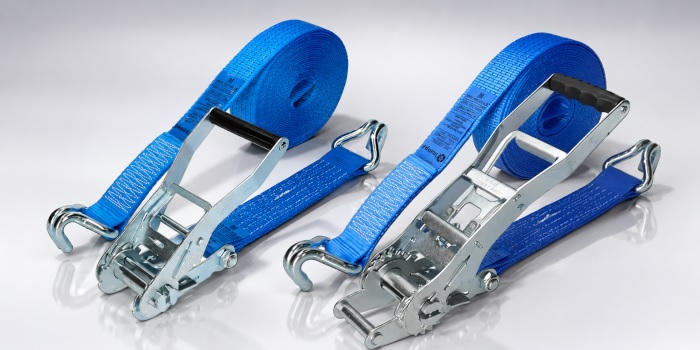
Side-by-side comparison: standard 5 tonne ratchet strap vs ERGO ratchet strap

The practical choice

ERGO ratchets primarily change the leverage and the direction the handle is operated in, not the lashing's inherent capacity. A long handle and downward pull can make tensioning more convenient and allow a higher standard tension force (STF) with less effort. However, a standard strap and an ERGO strap can have the same lashing capacity (LC). Neither the word 'ERGO' nor a '5 Tonne' sales description permits a 5 tonne load to be secured with one strap. Your selection should be based on the actual label and a load-specific securing assessment. [1]

For repeat tie-down work, consider ERGO where the marked STF, operating clearance and load compatibility would be useful. A standard ratchet remains a sensible option where space is tight or where its verified specification already meets the securing plan. Trial both with the intended load and vehicle before changing a fleet specification.

Scope of this comparison

This guide compares common 50mm polyester, two-part road transport lashings: a standard long wide handle push-up ratchet, and a long-handle reverse-action pull-down ERGO ratchet. These are representative configurations, not definitions of every product sold under those names. Hook design, lengths, finishes, ratings and additional mechanisms vary by model. It is not a lashing-count calculation or a substitute for training, manufacturer's instructions or a competent load-securing assessment. [2]


Read the label, not just the '5 Tonne' description when specifying or buying

The three force markings below answer different questions. A decanewton (daN) is a unit of force, not a unit of cargo mass. Do not translate a marketing description into a permissible load weight.

Do not treat kilograms of cargo as interchangeable with daN of force, or infer a safe cargo weight from a hook's sales description. The complete assembly and its anchorage are only as strong as their weakest component. Load arrangement, friction, angles and other restraint measures still matter; a stronger-looking hook does not remove that assessment. [1]

Marking What it tells you How to use it
LC – lashing capacity Maximum force for which the lashing is designed in straight-line use. Relevant to direct-lashing assessment; check the marked value and configuration.
STF – standard tension force The working pre-tension associated with the marked standard hand force. Relevant to frictional, over-the-top tie-down assessment; it is not LC.
SHF – standard hand force The hand force (50daN (kg) used to establish the stated STF Read it with STF and follow the operating instructions; it is not the strap's capacity.

DVSA guidance distinguishes LC (used in assessing direct lashings) from STF (used in assessing frictional tie-downs). The required arrangement also depends on friction, lashing angles and blocking, including gaps to the headboard. There is no universal strap count for a load described only by its mass. [1] [2]


Compare the two types here

Published assembly Straight-line LC STF Other stated details
Standard Push Up to Tension Ratchet 2,500 daN 350 daN 50mm wide 7.5Te polyester webbing, 5 stripes, zinc-plated ratchet and claw hooks, manufactured and labelled in accordance with BS EN 12195-2:2001, handle length 230mm
ERGO Pull Down to Tension Ratchet 2,500 daN 500 daN 50mm wide 7.5Te polyester webbing, 5 stripes, zinc-plated ratchet and claw hooks, manufactured and labelled in accordance with BS EN 12195-2:2001, handle length 361.5mm

These examples illustrate equal LC with different STF, not a rule that all standard straps are rated at 350 daN or all ERGO straps at 500 daN.


Features and practical benefits

Feature Standard long wide handled ratchet Long-handled ERGO ratchet
Tensioning action Upward push on the handle in the configuration considered here. Reverse-action downward pull. DVSA notes that a downward pull allows more pressure than an upward push. [1]
Leverage and effort Shorter handle; may require more effort to achieve the required tension. Longer lever can help the operator generate tension. A qualitative convenience benefit, not an injury-prevention guarantee.
LC Determined by the marked assembly, not by being 'standard'. Not inherently higher: the representative models above both have LC 2,500 daN.
STF Model-specific. The example above is 350 daN. May be higher; the example is 500 daN. Check the exact label. Geared versions of the ERGO ratchet are also available with 650daN and 950 daN STF.
Access and clearance A shorter mechanism may be easier in confined spaces. Check the available space to tension and just as importantly release. Allow room for the longer handle and full downward stroke. Trial against bodywork, load edges and operating position.
Webbing, hooks and length Polyester webbing and zinc-plated hardware are available; exact fittings and lengths vary. Similar materials and finishes are available. 'ERGO' does not establish hook compatibility or assembly length.
Purchase cost Obtain a like-for-like quotation for the required specification. More expensive but the benefits of reduced operator strain and the longevity of a more robust mechanism outweighs the additional cost. A standard ratchet is like driving without power steering, whereas an ERGO is with!


What higher STF does, and does not, buy

In an over-the-top frictional tie-down, pre-tension helps create the clamping force on which the securing arrangement relies. DVSA notes that UK straps are usually rated at STF 350 daN or lower, while some loads may need 500 daN or more to reduce the number of lashings. That is a conditional planning benefit, not permission to remove straps automatically. The load, friction, angles and other securing measures still govern. [1]

Greater tension can also damage crushable or vulnerable cargo. ERGO's leverage is useful only when that tension is appropriate; a standard ratchet can also over-compress a load. Use suitable edge protectors and assess the cargo, packaging and support beneath it rather than tightening as hard as possible. [1] [2]


Balanced pros and cons

Standard ratchet: compact and fit for purpose

  • Advantages. The shorter mechanism can suit restricted working spaces and may be convenient where a compact mechanism is preferable. Where the marked STF and LC meet the securing plan, there is no capacity-based reason to replace it simply because an ERGO alternative exists. Standard assemblies also offer different hooks, lengths and finishes, so the label and complete assembly matter more than the category name.

  • Limitations. The upward push and shorter lever may be less convenient for repeated tensioning than a suitable long-handle pull-down model, particularly if the ratchet is being tensioned in an elevated position. A lower-STF model may not provide the pre-tension assumed in a securing plan that calls for a higher value. Do not compensate by improvising handle extensions or assuming that the '5 Tonne' description supplies the missing tension performance; always follow the manufacturer's instructions. [1]

ERGO ratchet: leverage with conditions

  • Advantages. The longer handle and downward pull can make it easier to apply tension, particularly where the operator has a suitable working position. A specifically marked higher STF may be valuable for frictional tie-down work. The representative ERGO assembly achieves this without increasing its straight line LC above the standard example. [1]

  • Limitations. More operating clearance is a practical consideration, and higher available pre-tension is not suitable for every load. The category name does not guarantee a particular STF lower whole-life cost. Operator preference and potential convenience should be checked in a practical trial, to establish the safety, security and operational benefits.


Recommendation and safe application

Choose for the job, not the headline rating

Choose a standard ratchet strap when its actual LC and STF meet the assessed requirement and its shorter mechanism works better in the available space.

Consider ERGO when a verified higher STF or the downward operating action offers a useful benefit and there is adequate clearance.

For mixed work, a controlled selection of both types may be more appropriate than one fleet-wide assumption.

Before purchase, confirm the complete assembly's label, compatibility with the load and anchors, and manufacturer's instructions. Price comparisons should be like for like; no matched quotations or comparative operating tests underpin this guide, so no financial or productivity savings are claimed.


Rules that apply to both types

Inspect straps before use, protect them from sharp edges, and use compatible attachment points in good condition that can withstand the expected forces. Lock the ratchet once the correct tension is achieved. Never knot tensioned webbing. Replace significantly damaged straps and straps with missing fittings; store straps dry and covered, and arrange recorded checks at least every six months. These are shared requirements, not ERGO-specific recommendations. [1]

Neither type gains lifting capability from its rating or mechanism. The product standard ratchet straps are made to expressly prohibit lifting. Road-load restraint must be planned for the specific load; the DVSA identifies BS EN 12195-1:2010 for calculating securing forces and BS EN 12195-2:2001 for web lashings as recognised references, not road-traffic legal requirements in themselves. [2]


Procurement and operator-trial checklist

  • Confirm the marked LC, STF and SHF for the exact complete assembly.

  • Check the applicable standard, manufacturer's instructions and traceable label details, including manufacturer, date/batch and length.

  • Verify hook/anchor compatibility, required length and width, and hardware finish.

  • Trial handle clearance, operating position, tensioning and locking on the intended vehicle.

  • Assess edge protection and the load's tolerance of compression.

  • Obtain like-for-like quotes, then include operators in a practical trial before approval.

Buy 5 Tonne Ratchet Straps from Tensys Direct   Buy ERGO Ratchet Straps from Tensys Direct

Sources

Numbered references apply to the factual claims above. Product pages are representatively published specifications, not evidence that every item in a category shares those ratings. DVSA guidance is the primary reference for UK applications.

[1] DVSA – 'Securing loads on HGVs and goods vehicles: 4. Ways to secure a load in an HGV or goods vehicle'. Updated 24 September 2026. Sections: 'Understanding the strap label', 'Ratchets', 'Keeping straps in a usable condition' and 'Attachment points'. https://www.gov.uk/guidance/securing-loads-on-hgvs-and-goods-vehicles/4-ways-to-secure-a-load-in-an-hgv-or-goods-vehicle

[2] DVSA – 'Securing loads on HGVs and goods vehicles: 2. Load securing: the basics'. Load-specific assessment and recognised standards. https://www.gov.uk/guidance/securing-loads-on-hgvs-and-goods-vehicles/2-load-securing-the-basics
50mm Ratchet Strap Hooks

Two straps can be the same width and still need very different endfittings to attach safely. The hook is the small detail that decides whether the strap secures properly on your vehicle, follows a sensible line of pull and stays where it belongs while you tension it.

This guide compares familiar hook profiles, then looks at specialist car-transport and tracking fittings. It's intended as a practical selection guide, not a restraint calculation or a technical design instruction. Always check the actual strap, fitting and vehicle guidance before use.


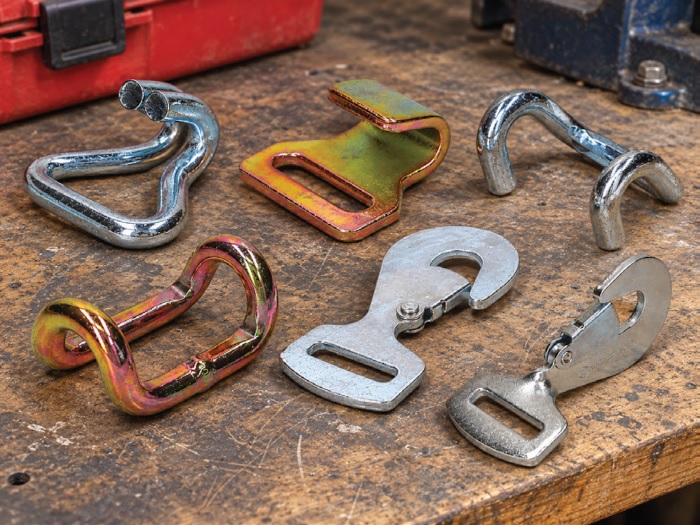
PICTURED ABOVE (LEFT TO RIGHT):
Claw Hook // Combi Hook // Open Rave Hook

PICTURED ABOVE (LEFT TO RIGHT):
Closed Rave Hook // Flat Snap Hook // Twisted Snap Hook


Start with the anchorage, not the hook name

A hook must match an approved load-securing point, not simply something it can catch around. A sound connection on one trailer may be unsuitable on the next. DVSA guidance calls for adequate strength, compatibility and minimal movement without distortion. [1]

The fitting should bear where its manufacturer intends, with the pull in the permitted direction, rather than balancing on its tip or being levered sideways. Always ensure that the anchor point used fits into the base radius of the hook with clearance – never force the hook onto too large a diameter of anchor, as this may cause premature failure. See our previous blog post Choosing the Correct Hook Size for more information on this topic.


50mm is a width, not a capacity

The width describes the webbing, not the load you can safely carry. Read the complete assembly's legible label, including its BS EN 12195-2 identification and the ratings that are relevant to your restraint method. If you're not sure how to read the product label, see our previous blog post Ratchet Strap Labels: What Do All the Different Terms Mean?

Lashing capacity (LC) is a force used for direct-lashing calculations. Standard tension force (STF) describes the tension produced under standard conditions and is relevant to frictional tie-down restraint, the force that the tensioned strap applies to the load. Breaking strength BFmin is a failure measure, not a working limit or a way to choose the number of straps. [1]

Do not treat kilograms of cargo as interchangeable with daN of force, or infer a safe cargo weight from a hook's sales description. The complete assembly and its anchorage are only as strong as their weakest component. Load arrangement, friction, angles and other restraint measures still matter; a stronger-looking hook does not remove that assessment. [1]


Meet the eight hook types

Claw / double J

A familiar general-purpose profile

A double-finger J fitting, commonly known as a claw hook, is offered for 50mm webbing in commercial vehicle load securing. Its job is to connect the strap to a compatible approved anchorage, such as a suitably sized lashing ring or side rave on a trailer or goods vehicle. For palletised freight, this can be a straightforward choice when the ring lets the hook seat fully and the intended pull stays aligned. It is not a promise of fit on every ring: reject a connection that traps only the tips, wedges the hook or loads one side awkwardly. Claw hooks are often used to connect to the main chassis of the trailer or the goods vehicle too.

Buy 50mm Claw Hook


Single pole claw hook

A similar style to the common claw hook, J-shaped but formed from a single wire rod

An alternative to double J claw hooks, ideal for situations where access is restricted and a smaller tip diameter is required. A typical 5000daN (kg) double J claw hook measures 23mm across the tip, whereas the single version is 15mm.

Buy 50mm Single Claw Hook


Flat J / flat hook

A broader bearing profile

This plate-like profile differs from the round-wire claw. Consider using this hook type in situations where the vehicle maker approves a matching rail or anchorage profile, for example on a flatbed carrying building materials. Its broad appearance does not make an arbitrary bodywork edge a load-securing point. Check the opening, seating depth and intended bearing face against the actual anchor. Thin sheet metal, an unsuitable lip or an edge that prevents full engagement is a reason to choose another approved connection, not to force this one on. This design of combi flat hook will fit the commonly-fitted side rave drop in lashing rings that are TT shaped.

Buy 50mm Flat Hook


Open rave / chassis

For a matching vehicle profile

A 50mm wire rave hook fitting is intended for suitable vehicle side-rave or chassis attachment. It can therefore suit general freight on a trailer whose approved securing arrangement uses that profile, rather than a lashing ring. The key word is 'suitable': the visible chassis is not automatically an anchorage. Check that the hook seats securely and squarely without distortion and is approved for the pull you need. With an open profile, pay particular attention to whether it can disengage while the strap is slack during fitting.

Buy 50mm Rave Hook


Closed rave / chassis

Closed does not mean locking

Open and closed rave profiles are available. A closed wire form is not a spring-locking hook; it doesn't have a locking function, the word 'closed' just describes how the shape of the hook is formed. Select it for a compatible approved side-rave or chassis point, such as a trailer arrangement specified for that fitting. Do not assume its name guarantees retention on every anchor, or that it will engage an anchor which takes the open version. One side of the hook will have a gap where the two sides of the wire road are formed together; this may be welded or left with the 2 sides close together. Webbing should never be fitted to this side of the hook as it's not load bearing in this direction of pull.

Buy 50mm Closed Rave Hook


Flat snap

A catch for retention

A flat snap fitting uses a spring catch across its opening. Consider it where a compatible lashing ring is approved and keeping the connection in place while positioning the strap is useful, for example when securing trade equipment in a goods vehicle or as a crane securing strap on a builders merchant vehicle. The ring must sit inside the hook's intended bearing area and let the catch close fully. The latch is a retention feature; it is not designed to bear a load. If the anchor presses on the catch or holds it open, the connection is wrong, regardless of how firmly the ratchet is tightened. Never use a hook where the catch is missing or damaged.

Buy 50mm Flat Snap Hook


Twisted snap

A different webbing orientation

Twisted snap fittings also have a spring catch, but offer a different orientation from the flat version. Where approved for use, this geometry may suit a ring and webbing route that would otherwise leave the strap poorly aligned, for example on a vehicle with differently oriented anchorage rings. This is a selection consideration, not permission to twist the webbing to make it fit. A twisted snap hook is not a swivel. Check the actual product drawing and permitted pull direction; neither the catch nor the twist makes side-loading good practice.

Buy 50mm Twisted Snap Hook


Claw hook with safety catch

Shape and retention are separate choices

Spring-catch claw variants also exist. So 'claw' describes a profile as in the wire-formed J shape described above, while 'snap' describes a retention feature which is normally a spring loaded catch; a fitting may combine both. Ask for the exact part or assembly reference rather than relying on a name or photograph alone. Refer to the dimensional drawings for the endfitting when making an informed choice. Claw hooks with safety catches come in several sizes to suit different diameters; there are versions to suit up to 15mm, 24mm and 30mm Ø bars or lashing points. The larger 30mm version is commonly used to connect to the lashing bars on container flat racks.

Buy 50mm Claw Hook with Safety Catch for 15mm Bar Buy 50mm Claw Hook with Safety Catch for 30mm Bar


Specialist fittings are a different conversation

For car transport, identify the complete approved wheel-restraint system and its specified deck connection (e.g whether punched decking or ring type lashing points). A single swivel fitting is not a generic replacement for a claw hook; its mating aperture, engagement and permitted orientation must match the transport system. On multi-car transporters, the hook strength is often limited to 3000daN (kg) breaking force because the hook wire diameter is smaller than for 5000daN(kg) hooks to allow fitting into the punched decking.

For securing roll cages and other loads within box vans, a tracking fitting must match the particular load-restraint track and its rating, not merely slot into a convenient opening. Care has to be taken not to damage the load, tracking or the vehicle/trailer side walls.

Do not mix fittings between tracking families or assume that all perforated decks accept the same connector. If the equipment needs a specialist connection, buy the specified assembly.


A practical choice checklist

Before ordering or fitting a strap, work through these checks. The application examples above are conditional starting points, not approval for a particular vehicle or load.

  • Identify the approved anchorage and confirm its strength, dimensions and permitted load directions with the vehicle or equipment supplier.

  • Match the exact hook profile and opening to that point. Check full seating, clearance and any catch operation before tensioning.

  • Choose the complete labelled assembly for the restraint method. Check LC and, where relevant, STF; do not select by webbing width or breaking-strength headlines alone.

  • Check the webbing route. Avoid twists, sharp or abrasive contact and any hook position that creates tip-loading, side-loading or leverage.

  • Inspect the webbing, stitching, ratchet, hooks and anchorage before use. Remove damaged equipment from service and use suitable edge protection such as sleeves or plastic corner protectors.

  • Confirm the load-securing plan, not just the connection. If fit, rating or the required restraint is uncertain, stop and obtain competent advice.


Habits that matter whichever hook you choose

Never use sheeting or rope hooks as load-securing anchorages. The triangle shape formed by the 2 sides of the claw hook closed together should never be placed over a rope hook as the hook is not load bearing at this point (the weld at this point is to retain the shape of the hook during the heat treatment and corrosion-plating processes). The DVSA also says not to attach more than one lashing to an anchorage, or thread a lashing through a point and hook it back to itself. Inspect before use, protect webbing from sharp or abrasive edges, and replace damaged webbing or end fittings rather than carrying on with a strap that is not in good condition. [1]

Ratchet lashings are for securing loads, never for lifting. A catch that sticks, a distorted hook, damaged stitching or an unreadable label deserves attention before the next job, not after it. A replacement fitting should be approved as part of the assembly; do not improvise a repair because the replacement happens to accept 50mm webbing.


The right hook is the one that genuinely fits

There is no single best hook for every 50mm strap. Start with the approved anchorage, choose the profile and retention arrangement that works with it, then check the whole assembly and restraint plan. A well-matched connection is more useful than an impressive-looking hook or a bigger number in a product headline.


Sources and editorial notes

DVSA provides the overarching safety guidance. Manufacturer pages identify example fitting types, not universal compatibility or ratings. Application suggestions are editorial guidance subject to product and vehicle approval. Figures in source titles are retained verbatim and are not ratings for every 50mm strap.

[1] DVSA – Securing loads on HGVs and goods vehicles: 4. Ways to secure a load in an HGV or goods vehicle. Updated 24 September 2026.

Buy Endfittings from Tensys Direct