
Tensys
EX VAT
INC VAT
0 items £0.00
YOUR BASKET

You have no items in your basket

Archive

Measuring the height of a heavy goods vehicle

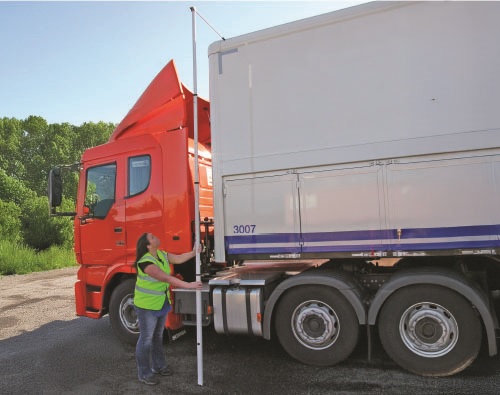
The safest and most accurate way to measure the combined height of your vehicle and its load is to measure from the ground to the highest point of the vehicle or load after everything has been fully loaded up and secured.

Height measuring sticks (telescopic load height poles) are commonly used in the transport industry specifically for this purpose.

According to Network Rail, bridge strikes cost the UK economy about £23 million every year, with an average cost of £13,000 for each individual incident. Network Rail now tries to recover 100% of these costs from the transport company or driver responsible. Investing a few hundred pounds in equipment and training significantly reduces the potential risk.

The following pages have some useful information on this topic:


Method 1: Telescopic Height Pole (Recommended)

  1. Park on level ground.

  2. Load and secure the vehicle exactly as it will travel.

  3. Extend the height pole beside the vehicle until it touches the highest point.

  4. Read the measurement directly from the scale.

  5. Record the height in the cab and on any transport documentation if required.

This is the quickest vehicle/load height measurement method for flatbeds, curtain-siders carrying awkward loads, plant trailers and abnormal loads.


Method 2: Measure Vehicle Height + Load Height

If you don't have a height stick that would allow you to measure the full height of the loaded-up vehicle, you can use this method instead:

  1. Measure the trailer deck height from the ground.

  2. Measure the load height from the trailer bed to the highest point of the load.

  3. Add these two measurements together

For example, if your trailer deck height is 1.35 metres and the load height is 2.5 metres, the total height of your loaded-up vehicle will be 3.85 metres.


Best Practices

For haulage operators, we normally recommend:

  • Measuring every unusual or high load.

  • Writing the overall height on a dashboard card or display, and keeping this within sight for quick reference against bridge road signs.

  • Checking for route restrictions before departure (see below for advice).

  • Re-measuring to confirm your vehicle height if it's close to 4.95m or any route restriction.

  • Bearing in mind that suspension changes and tyre pressures can alter vehicle height slightly.

  • Ensuring that all equipment is securely lashed and locked in position so that (for example) booms and jibs can't extend during the journey.


Route Restrictions

Before setting off with a loaded vehicle, these are the key route restrictions that should be checked:


1) Bridge Height Restrictions

This is the most critical check for high loads. Look for...

  • Low bridges
  • Railway bridges
  • Footbridges
  • Temporary bridge works
  • Locations of past bridge strikes

Your measured vehicle height must be lower than the posted clearance. Bridge strikes are a significant cause of infrastructure damage and transport incidents, so don't drive under a bridge unless you know for sure that the combined height of your vehicle and load is low enough to fit.


2) Overhead Services

Bridges aren't the only overhead hazard you need to be mindful of. You should also check for...

  • Power lines
  • Telephone and data cables
  • Pipe bridges
  • Conveyor crossings
  • Overhead gantries

These can be lower than standard road structures, particularly in industrial estates, ports and construction sites.

Here at Tensys Direct, we stock height sticks with imperial and metric scales to help you measure your vehicle's height easily and accurately. Click the button below to browse and buy.
Buy Measuring Sticks from Tensys Direct

CE mark

When purchasing ratchet straps and other types of load restraint equipment, buyers are often told to look for a CE mark as evidence of compliance and safety. While that may be good advice for some products, it doesn't apply to web lashings manufactured to BS EN 12195-2:2001.

In fact, for transport operators, fleet managers and procurement teams, focusing on CE marking can distract from the information that actually matters when it comes to securing loads safely and demonstrating compliance.


What to Look for Instead

Web lashings used for load restraint on road vehicles are covered by BS EN 12195-2:2001, the recognised standard for web lashings manufactured from man-made fibres. This standard specifies requirements for design, manufacture, testing, marking and traceability.

When a driver secures a load, the important information is not whether a CE logo appears on the strap. What matters is whether the lashing has been manufactured and labelled in accordance with BS EN 12195-2.


Why CE Marking Isn't Relevant

The CE mark is only needed where specific legislation requires it. Not every product sold in the UK or Europe falls within this framework.

BS EN 12195-2 is a widely recognised product standard for load restraint equipment, but it is not a CE harmonised standard that requires manufacturers to apply a CE mark to their web lashings. Industry guidance and manufacturer documentation consistently recognise that lashings should demonstrate compliance through the requirements of BS EN 12195-2 rather than through CE marking.

For transport operators, this means that a strap without a CE mark is not necessarily non-compliant. And a strap that does have a CE mark is not automatically superior or safer.


Questions to Ask When Buying Ratchet Straps

Rather than asking suppliers whether their straps are CE marked, buyers should focus on the information that's directly relevant to load security and compliance.


1) Is the strap clearly labelled?

BS EN 12195-2 requires lashings to carry specific information, including:

  • Lashing capacity (LC)
  • Standard tension force (STF)
  • Standard hand force (SHF)
  • Strap material
  • Manufacturer details
  • Traceability information
  • Reference to EN 12195-2

This information allows operators to verify that the lashing is suitable for the application and provides the data needed for load securing calculations.

SEE ALSO: How to Read the Information on a Ratchet Strap Label


2) Is the manufacturer traceable?

Every professional transport operation should be able to identify where its restraint equipment came from.

Traceability enables:

  • Product recalls if required
  • Investigation of failures
  • Verification of test records
  • Demonstration of due diligence


3) Can the supplier support performance claims?

Buyers should be looking for:

  • Documented testing
  • Quality assurance procedures
  • Consistent manufacturing standards
  • Product traceability

These factors provide far greater assurance than the presence of a CE mark or any other logo on the label.


Why Label Information Matters During Roadside Inspections

During DVSA inspections, enforcement officers are interested in whether appropriate load securing equipment is being used.

The key information is normally found on the BS EN 12195-2 label. If a strap's label is missing, damaged or illegible, essential information such as the lashing capacity cannot be verified. Industry guidance notes that lashings without proper identification should not be used because compliance cannot be established.

For fleet operators, maintaining properly labelled restraint equipment is therefore far more important than
seeking out unnecessary product markings.


Avoid Being Misled by Marketing Claims

The transport industry has become increasingly familiar with terms such as:

  • "CE approved"
  • "CE certified"
  • "CE compliant"

But for ratchet straps and web lashings, these claims often create confusion rather than clarity.

As a buyer, your responsibility is to ensure that restraint equipment is fit for purpose and compliant with the relevant load restraint standard. The correct question is not "Is it CE marked?" but rather "Is it fully compliant with BS EN 12195-2 and correctly labelled?". That's what will give you meaningful assurance about the suitability of the product for load securing operations.


The Bottom Line

For transport operators, logistics companies and procurement professionals, the safest purchasing decision is to focus on compliance with BS EN 12195-2:2001, not on CE marking.

A quality lashing should provide:

  • Clear EN 12195-2 identification
  • Declared LC, STF and SHF values
  • Full traceability
  • Manufacturer information
  • Evidence of testing and quality control

These are the features that help keep loads secure, drivers safe and operators compliant.

When buying ratchet straps, don't ask for a CE mark. Ask for compliance with BS EN 12195-2. That's the standard that matters.

Buy Ratchet Straps from Tensys Direct

Ratchet buckle

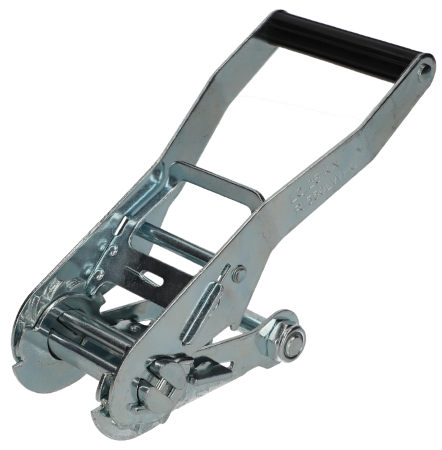
To keep your ratchet buckles in optimum condition, we recommend regular lubrication after cleaning.

Recommended lubricant

Use a light dry silicone spray or PTFE dry lubricant on pivot points, gear teeth and the release mechanism. These sprays are commonly available and you may already have a supply in your workshop. Popular brands are WD40 Dry Lubricant (not standard WD40), GT85 and Action Can SP90 etc. Avoid heavy grease or over-application, as excess lubricant can attract grit and contaminate the webbing.

Apply a light spray to hinge pins, pawl, ratchet wheel teeth and release mechanism. Diagrams below shows the key areas to spray.

Lubrication tips

  • Operate the handle several times to distribute lubricant through moving parts
  • Wipe away all visible excess lubricant, especially near the strap path
  • Re-lubricate if the ratchet feels stiff, after heavy outdoor use, or after washing

Buy Ratchet Straps from Tensys Direct